 |
||
|
||

Home > TERATEC FORUM > Workshops
 |
The essential meeting place for all digital players Simulation . HPC/HPDA . Artificial Intelligence . Quantum Computing |
Workshop 01 - 4:00 pm to 6:00 pm |
Trust in High-Performance Computing: Ensuring Accuracy in the Age of AI
Beyond mixed precision: a short introduction to adaptive precision computing
Théo Mary, CNRS researcher, LIP6 laboratory, Sorbonne Université
|
|
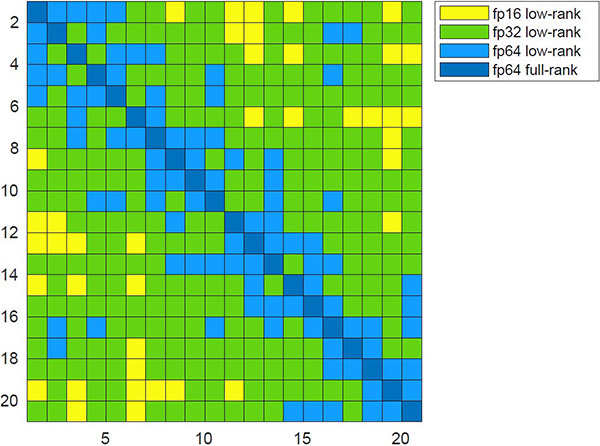
This talk aims at providing a short introduction to adaptive precision algorithms. I will explain their main principles, and what makes them more powerful and expressive than traditional mixed precision algorithms. By the latter, I refer to an algorithm that exploits a small number of precisions that are statically fixed in advance. In contrast, adaptive precision algorithms:
I will illustrate these principles with some successful examples in linear algebra and beyond. |
|
|
Biography: Theo Mary is a CNRS researcher at the LIP6 laboratory of Sorbonne Université in France. His research concerns the design, development, and analysis of high-performance parallel numerical algorithms, with a particular focus on numerical approximations. He received several awards, including the SIAM Activity Group on Linear Algebra Early Career Prize, the Médaille de bronze du CNRS, and the Lanczos ECMI/EMS Prize for Mathematical Software. |


To participate in this workshop, please register on the Teratec 2026 Forum website >>>>